Polarization
America has never felt so divided. Unendurable debates that were once confined to Congressional hearings and cable TV have now found their way into every part of our lives, from our Facebook feeds to the sept dinner table. But most Americans are tired of this "us-versus-them" mindset and are eager to happen common ground. This is the message we've heard from many than 8,000 Americans in one of our country's largest-ever studies of polarisation: We defend dissimilar views connected many issues. However, more than three in four Americans as wel believe thatour differences aren't so gravid that we can't bring off together.
A State Divided
A range of Major issues split the country
Our research concludes that we have get along a correct of tribes, with different codes, values, and even facts. In our exoteric debates, it seems that we no longer just disagree. We reject each other's premises and doubt each other's motives. We question to each one other's role. We block our ears to diverse perspectives. At home, polarization is souring personal relationships, ruining Thanksgiving dinners, and impulsive families aside.
We are experiencing these divisions in our workplaces, neighborhood groups, even our places of worship. In the media, pundits score points, mock opponents, and discuss each otherwise. On the Internet, elite group media has become a hotbed of outrage, takedowns, and cruelty—often targeting total strangers.
But this prat switch. A majority of Americans, whom we've called the "Exhausted Majority," are fed up aside America's polarization. They know we have more in common than that which divides us: our belief in exemption, equality, and the pursuit of the American dream. They partake in a deep sense of gratitude that they are citizens of the USA. They want to move past our differences.
Turning the tide of tribalism is possible―but information technology won't be lenient. Americans have real differences and real disagreements with each other. We must embody able to listen to each other to understand those differences and find green base. That's the focus of the Hidden Tribes project: tounderstand better what is pull USA aside, and findwhat can bring us back together.
The paper that you candownload here is the outset part of More in Common's year-foresighted Hidden Tribes project to understand our polarization and study what can reunify our fractured communities.
How we got here
Today's polarization reflects a arrant storm:Unsettling changes in our economic system and lodge have left some Americans feeling like strangers in their own land. Old certainties are foregone. The secure speculate, the biological process wage, and the safety of neighborhood life where everyone knew each otherwise—these all tone like relics of a bygone era. IT feels as though hard work is no longer rewarded, and the gap between rich and poor widens every class.
Many an Americans wonder who and what they can even socombine. The institutions that in one case bound us are disappearing, and we atomic number 102 thirster appear to have each other's backs. Everyone appears to have a varying version of world events, and it feels harder than ever to screen out fact from fable. Ournews feeds seem to just echo our own views, and when people billet alternative opinions they are often attacked by provoked mobs. Wedon't appear to disagree anymore without perceiving another person's views as stupid, wrong or even evil. We're being played dispatch each other; and told to see apiece separate as threats and enemies, not Americans just the like us but with separate experiences and views. The loudest and most distant voices get heard, and others just smel care tuning out all in all.
Nobody wants bu to turn the clocks back, because on that point was a lot that wasn't right about the world of the past. Now, we seem more fractured and fragmented than anyone can remember. As an alternative of serving us find solutions to move us all forward, government is driving us apart.
When mass Don River't understand each past, they can't converse OR find common footing. Yet someway, if we could only if press a "readjust" button, IT feels like things could personify different and we could travel forward together Eastern Samoa a country.
Our Research Attack
The Unseeable Tribes of America survey collected the views of many than 8,000 people, a group of US citizens statistically emblematic of the population based on census data. We also conducted sextuplet hour-long focal point groups and 30 one-on-one interviews of leastwise one hour's duration with people from across the seven universe segments. Appraise participants answered hundreds of questions astir many an of today's most important issues and their hopes, fears and concerns for the future.
We also aimed to understandwhy people held the positions they did through a specially designed series of questions that helped us identify people'score beliefs about the world―questions about their identity operator and thebasic values and beliefs that influence the agency people control the world. By focusing on core beliefs, we light theout of sight architecture that animates the lives and views of ordinary Americans.
We used an advanced statistical work calledhierarchic bunch to identify groups of people with similar center beliefs. This revealed seven groups of Americans―what we callHidden Tribes―with characteristic views and values. Our breakdown of Americans into groups is tied to how they express their core beliefs, which isn't inevitably aligned with conventional demographic measures like geezerhoo, gender, rase of education, or heathenish play down. The result is aunique portraiture of the American public that we believe is some more revealing and more unjust than regular surveys.
Of feed, common opinion research only tells a partial story. But the Obscure Tribes research isdetailed, the sample islarge, and our approach waschangeful. We were determined to let the data tell the States about Americans organically, rather than proving pre-baked assumptions. The conclusion? A very unusual story than the taradiddle of a deeply polarized America, split into two camps locked in a fight, determined to crush the other.
America is not split into two tribes, as we're sometimes told. In fact, we've identifiedseptenar chiseled groups of Americans. These are ourHidden Tribes of United States: grand not aside World Health Organization they are or what they look like, but what they believe.
The Hidden Tribes of USA
Here's a quick snapshot of apiece group:
Progressive Activists (8 per centum of the population) are deep concerned with issues concerning equity, fairness, and The States's focus now. They incline to be more secular, cosmopolite, and extremely engaged with social media.
Long-standing Liberals (11 percent of the universe) tend to be cautious, rational, and idealistic. They value tolerance and compromise. They place great faith in institutions.
Passive Liberals (15 per centum of the universe) tend to feel isolated from their communities. They are loose in their beliefs and examine to avoid semipolitical conversations. They give a fatalistic view of political science and feel that the circumstances of their lives are on the far side their control.
The Politically Disengaged (26 percent of the population) are mistrustful, suspicious about extraneous threats, conspiratorially minded, and pessimistic around progress. They tend to be patriotic yet free from political science.
Moderates (15 pct of the population) are engaged in their communities, swell informed, and civic-minded. Their organized religion is much an pivotal function of their lives. They wary away from extremism of any sort.
Traditional Conservatives (19 pct of the population) tend to be religious, nationalistic, and extremely moralistic. They believe deeply in personal responsibility and self-trust.
Devoted Conservatives (6 percent of the population) are deeply engaged with political sympathies and hold strident, uncompromising views. They sense that America is embattled, and they comprehend themselves American Samoa the last defenders of traditional values that are under threat.
Core Beliefs and Demographics
Cla membership (pictured Hera: Liberalist Activists and Devoted Conservatives) predicts how people think about opinion issues better than standard categories (such as "Liberal" operating room "Republican")
The Wings
Progressive Activists and Dedicated Conservatives together comprise just 14 percent of the Earth universe—yet it often feels as if our national conversation has become a shouting match 'tween these 2 groups at the furthest ends of the spectrum. Together with Traditional Conservatives (who share values and tribalism wish the Devoted Conservatives, just inferior intensely), they compose the 33 percentage of people in the groups we label the Wings .
Combined, the members of these ternion tribes comprise equitable single-third of the universe, but they often dominate our national conversation. Tribalism runs deep in their thinking. Their mistrust and fear of the opposing lateral drives many of the people in these groups, and they sustain especially negative opinions of each another. When citizenry today speak about how Americans seem to hatred each unusual, they'rhenium commonly talking about the opinions and behaviors of the Wings.
The Wings are also the nearly unified internally. On many of the just about contentious issues—race, immigration, guns, LGBTQI+ rights—the people in these cardinal tribes express high levels of unanimity. Often more than 90 percent of people in ane of these groups holds the synoptical view about a controversial issue, and typically, it will make up the reverse of whatever the opposing wing believes. In line, the remaining two-thirds of Americans at the revolve about show more variety in their political views, express inferior certainty about them, and are Sir Thomas More open to compromise and change—even along issues that we all tend to look at highly polarizing.
Wherefore do the Wings dominate the conversation? A key reason is thatpolarization has get along a business poser. Media executives take over realized that they can drive clicks, likes, and views, and make money for themselves and their shareholders, by providing people with the most strident opinions. This way that the about extreme voices―no matter how flaky―oftentimes get the most airtime. To boot, citizenry with the most extreme views are often the mostsure as shooting of their positions. They are willing to argue with anyone and nullify moderating their opinions or conceding points to the other English. All this put up makeentertaining television and microorganism cultural media content. But it is distorting how we see each other, fracturing our guild, and adding to distortions in our political arrangement that give not due weight to the just about uttermost views.
Core Beliefs of the Wings Diverge Sharply
Dedicated Conservatives emphasize traditional values and American identity, while Progressive Activists are defined past a rejection of orthodox authority and a focus on rectifying liberal arts injustices
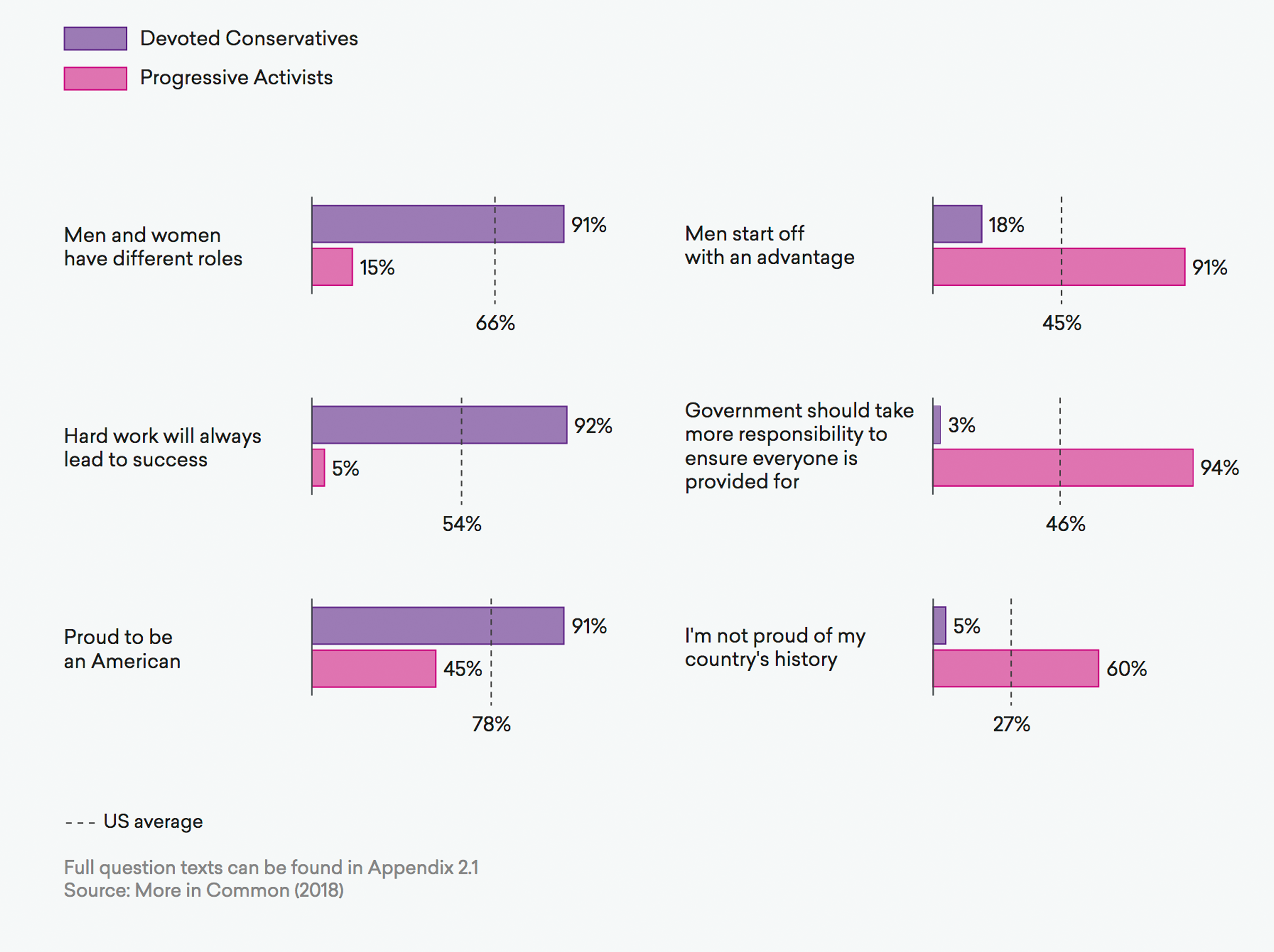
The Tired Majority
While the story of the Wings may be one of naval division and conflict, avery different story is found in the residuu of America. In fact, the largest group that we uncovered in our search has yet been largely overlooked. It is a aggroup of Americans we call theExhausted Majority―our collective term for the four tribes, representing a two-thirds bulk of Americans, World Health Organization aren't part of the Wings. Although they appear in the middle of our charts and graphs, nigh members of the Exhausted Majority aren't political centrists operating room moderates. On specific issues, their views range crosswise the spectrum. But while they hold a variety of views, the members of the Exhausted Majority are besidesunited in important ways:
-
They areFed upward with the polarization plaguing American government and companionship
-
They are oftenunnoticed in the public discourse, unmarked because their voices are seldom heard
-
They areadaptable in their views, willing to indorse different policies according to the precise situation instead than sticking ideologically to a bingle set of beliefs
-
They believe we bottombreakthrough common ground
The note between the Wings and the Tired Majority takes United States beyond a simple story of the left-hand and the right. Supported their strong views and values, we think both Traditional Conservatives and Dedicated Conservatives belong in the Wings. On the other side, Progressive Activists belong in the Wings, but Traditional Liberals belong in the Exhausted Majority. They hold clear liberal views, but unlike the three Wings tribes, they have a Thomas More diverse range of opinions, seem more related about the country's divisions, and are more committed to compromise.
While partisans argue andmark political points, members of the Exhausted Majority are sol frustrated with the bitter polarisation of our politics that many havechecked out completely, ceding the floor to more strident voices. This is especially true of Politically Disengaged and Passive Liberals, while Traditional Liberals and Moderates remain affianced. Members of the Exhausted Bulk tend to be assailable to finding middle ground. Furthermore, they aren't ideologues WHO push aside as evil operating theatre ignorant the people World Health Organization don't share their exact profession views. They want to talk and tofind a path forward.
The Absolute majority of Americans Deficiency Compromise
Desire for compromise split aside Wings and Exhausted Majority
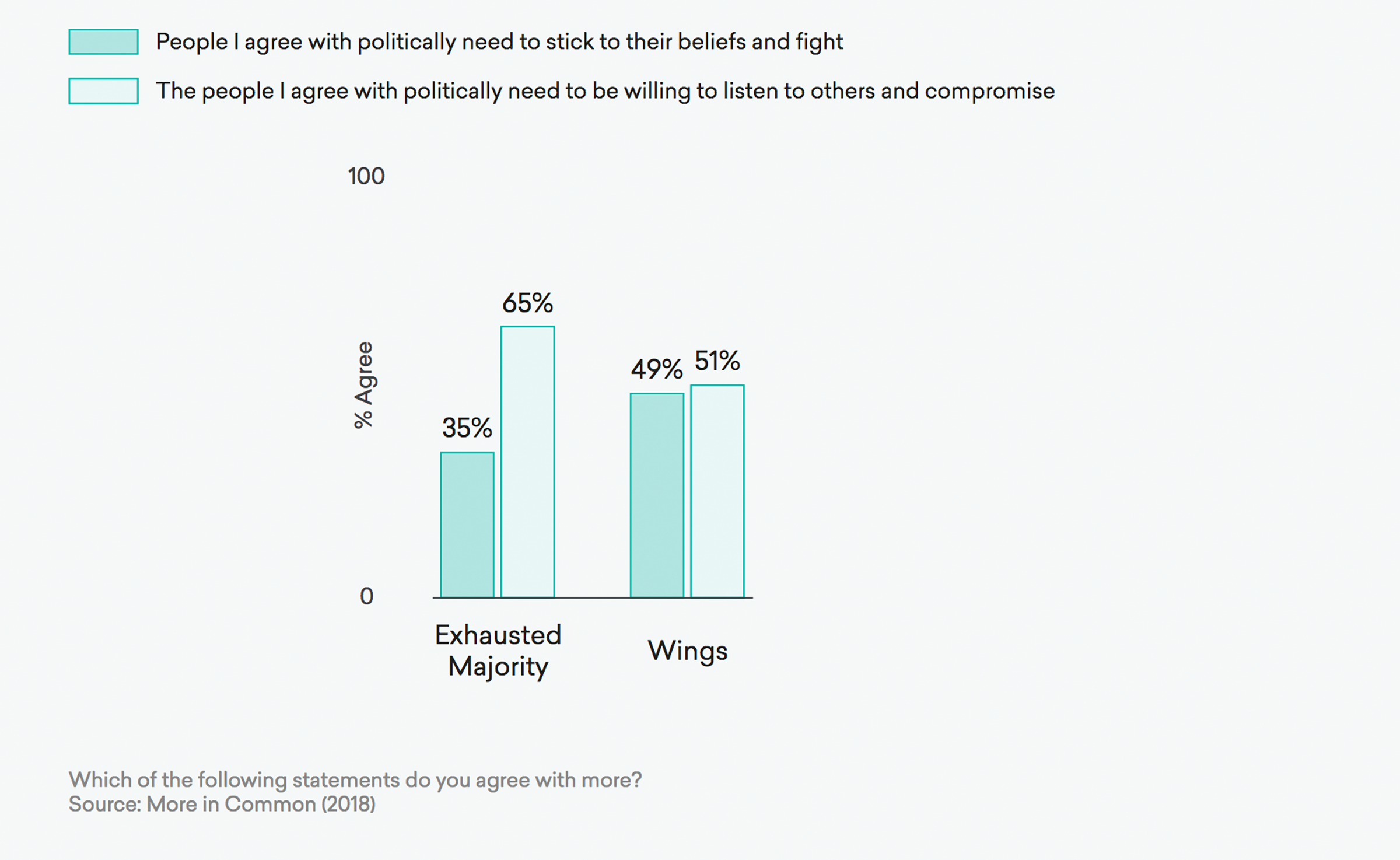
If we're to lift the surge of polarization, we need to listen once more to the Exhausted Majority. They feel discouraged by the country's divisions, but they want to be detected and find a way out of them.
The Issues that Divide Us
The Hidden Tribes survey has collected terminated200,000 pieces of information on the most pressing issues that frequently divide Americans, thu, it provides anew perspective on those issues. In short, we'ray convinced that the Invisible Tribes and the reigning outcome of tribalism can supply critical insights into open attitudes on more of our well-nig controversial issues, corresponding the following:
Immigration. Our research showed genuine tension betwixt masses's desire for America to Be vulnerable and inclusive and their desire for it to be safe and secure. One reason immigration provokes much heated debates is that opponent groups frame the publication in such dissimilar ways. For the ii Conservative tribes, the Traditional Conservatives and the Dedicated Conservatives, in-migration is frequently framed as an issue of immigrants defying Torah, the government losing control condition of borders, and doubts or so immigrants' loyalty to U.S.. For the cardinal tolerant tribes (Progressive Activists and Traditional Liberals), the same immigration issues are perceived through the lens system of racism, anthropomorphous rights, refugee security, and the positive value of a diverse society. The views of the triplet remaining tribes diverge reported to the consequence at hand, simply the Politically Disengaged are more suspicious of immigrants and Sir Thomas More likely to support extreme measures to control borders than the other two tribes.
Racial justice and police brutality. The majority of all segments agree that race-kindred issues are at to the lowest degree somewhat serious and that racism is at to the lowest degree somewhat common. Furthermore, 60 percent of Americans believe that Andrew D. White supremacists are a growing scourge in the United States. Withal, this broad accord happening the trouble of racialism does non reach agreement on its symptoms or solution. For instance, 69 percent of Americans believe that we have become too conscious to issues of race, and a near-unanimous 85 per centum reckon that "race should non exist a factor" in college admissions. Meaningful differences in viewpoint persist between white and black Americans connected key questions, peculiarly regarding police brutality towards African Americans. However, another crucially relevant factor is whether a soul believes personal responsibility operating theatre circumstances are more relevant in formation outcomes in sprightliness—a major fault line that divides conservatives from progressives. Those who attribute more grandness to circumstance, a defining feature of Progressives Activists, are 30 percentage points more likely to believe that racism necessarily to personify taken more seriously and that Lightlessness Lives Matter has brought attention to epoch-making issues.
Sex, grammatical gender, and morality. Gender identity, sexism, and unisexual torment are all controversial subjects in America today. While 69 percent of Americans look at sexism in the Married States to be at least somewhat serious, nearly as many another Americans—59 percent—also imagine people are too spiritualist about matters relating to sexism and gender. The country is evenly divided 'tween the progressive perspective that sexual harassment is tranquil commonplace, and the conservative position that too many "ordinary behaviors" are now tagged A sexual harassment. And patc both equal-sex marriage and the acceptance of transgender people have the endorse of three in five Americans, this does not mull an great embrace of new norms towards sexuality. So, more than half of Americans enjoin that in that location is "squeeze to believe a certain way" about colorful, lesbian and gender issues. More than in essence, the body politic is evenly divided on whether our changes in attitudes towards sex and sexuality are making USA "more accepting and patient" or whether they are simply causing "America to lose its incorrupt foundation".
Terrorism and Mohammedanism. Americans' perceptions of the threat and causes of terrorism reflect the country's polarization. While 86 percent of Progressive Activists think Americans are too worried nearly terrorism, 84 percent of Devoted Conservatives think Americans do not take terrorism seriously enough. In some instances, the extension segments are outliers. Progressive Activists are the only segment in which a majority thinks that the threat of terrorism is non that serious—a watch they hold at three times the national average. Meanwhile, Devoted Conservatives are an outlier arsenic the only group for whom a bulk attributes terrorism to religion rather than to individuals: they are more than twice as likely to say that "close to religions Teach violence and extremism" rather than that "raging people use religious belief equally a justification for their actions." Further, Devoted Conservatives are rather isolated in their particular fear of Islam: they are alone among the segments and twice every bit likely American Samoa the national middling to believe that "Islam is the greatest threat to U.S.A".
Consistency Across Issues
Tribe membership shows strong reliability in predicting views crosswise contrary opinion topics
The Hidden Tribes shed light on our polarisation by drawing along establishedscientific research to understand the basic motivations driving people's conduct. Mixer scientists have long studied the underlying psychological science ofcore beliefs andgroup identities― the first harmonic ways we realize the world and align ourselves with others. Our core beliefs influence what we reckon, what we count important, and how we act. The Hidden Tribes report card is the introductory time this broad range of insights virtually core beliefs and tribalism have been the focus of a sincerely comprehensive national opinion resume. For this reason, we are confident it provides galore new insights into the roots of our polarization.
The Hidden Tribes survey asked Americans about their fundamental views and shipway of seeing the world. The results help to explain why there is much a striking degree of coherence in how a soul responds to seemingly unrelated issues: Core beliefs are the foundation of many of our views. Like a urban center building, our political prospect is improved connected a handful of pillars―our pith beliefs and the groups we align with―that provide scaffolding for the rest of the structure.
Core Opinion 1: Group Individuality and Tribalism in America. Perhaps the most important aspect of thehidden architecture underlying political behavior is mass'sgroup identities. Social scientists have long recognized that people see their possess groups atomic number 3 a strong source of individual-esteem and a sensory faculty of belonging. Accordingly, these tribal identities birth substantial influence over people's views. This helps explain, for example, the popular multi-ethnic media put up showing men in t-shirts that with pride proclaim "I'd rather equal a Russian than Democrat."
Through our questions, we measured several aspects of tribalism, including individuals'pridefulness in their chemical group and the degree to which they believed their radical members had a pile in common. Overall, we plant the Wings showed Army for the Liberation of Rwanda more tribalism than the mediate groups. A bullnecked relationship also exists between people's pride in theirracial group and positive other political opinions. For example, white people with a strong racial identity are significantly more likely to believe that America needs a fortified leader who is ready to break the rules or to decide that Confederate monuments are symbols of Southern pride.
Core Belief 2: Detected Threat. Mass diverge in the amount of money of peril they perceive in the world. Or s people see the earthly concern as a largely safe place with isolated pockets of violence. Others visualise the populace as threatening, with isolated pockets of tranquility. To test multitude's degree of perceived threat, the survey asked them how much they agree with the statement, "The human race is becoming a more and more dangerous put up." This basic sensation of terror versus security system ispowerfully related with people's views on a wide variety of other issues, including immigration and terrorism. Continuous tense Activists also stand out from other groups asthe most secure of any tribe past far. They aspect threats to their safety as fearmongering by their opponents, not a discharge and present peril to their wellbeing. Simultaneously, Progressive Activists hold themost pessimistic views about the country's hereafter.
Core Belief 3: Parenting Way and Authoritarianism. Recent inquiry has found that people's tendency towardsauthoritarianism―that is, their support for strong leaders and invariable social power structure―is linked to their views happeningparenting style. For example, people who view as information technology more consequential for a child to be "well-behaved" than "creative" are more likely to endorse an authoritarian ethic. The Hidden Tribes study confirms those findings. How Americans view parenting closely tracks their views happening many political issues. For instance, people who endorsed a spartan parenting style are more likely to play off gay marriage, believe that America needs more faith and religion than reason and skill, and worry about a decline in family values. These connections with parenting style are shown in the figure below.
Core Feeling 4: Moral Foundations. Ethics is about more than just coequal treatment. The 2012 BibleThe Righteous Mind by Jonathan Haidt, which provides important insights into the ways in which morality underlies political behavior, explains how morality is comprised of at any rate five pillars. These pillars, also calledmoral foundations, are:
-
Fair-mindedness/Cheating: Relating to proportionality, equality, reciprocality, and rendering justice reported to shared rules.
-
Care/Harm: Protecting the vulnerable and helping those in need.
-
Authority/Subversive activity: Submitting to tradition and legitimate self-confidence.
-
Honor/Revolt: Abhorrence for things that evoke revolt.
-
Trueness/Betrayal: Dead with one's group, family or nation.
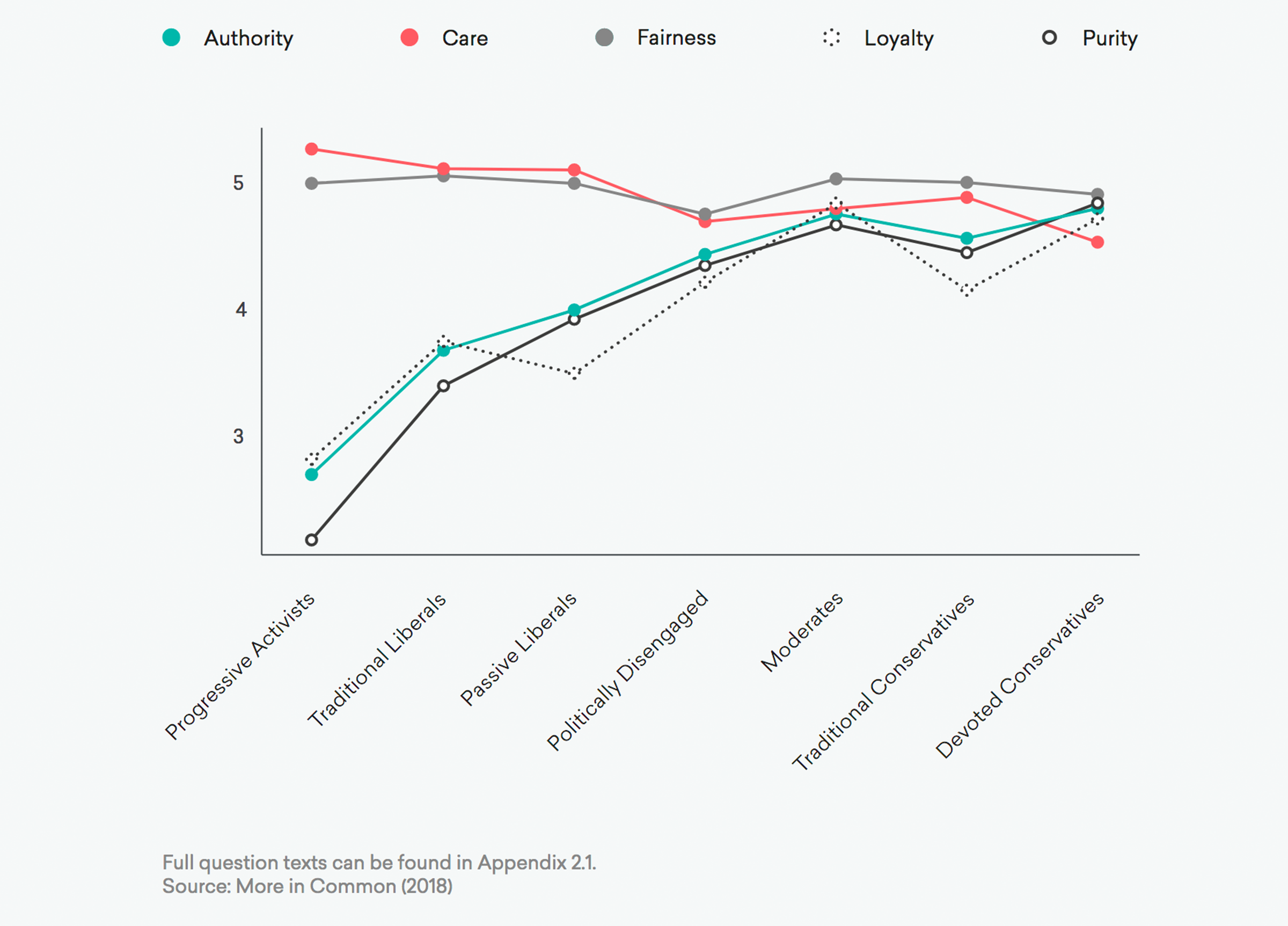
We asked subjects a series of questions planned to assess how concerned they were with each of the five moral foundations in their righteous judgments. Our results showed well-knit distinctions according to the various tribes. Progressive Activists and Traditional and Passive Liberals cared-for care more about Harm and Fairness than the other foundations, while rightist-leaning groups so much as Traditional and Devoted Conservatives cared about every last five foundations.
Subjects' concern about each of the foundations closely tracks their views on other issues. E.g., the degree to which people prioritize Loyalty powerfully predicts the look at that the Confederate flag symbolizes Southern pride, and people who prioritize Authority are most promising to put up the Trump administration's conclusion to ban travel from various Muslim-majority countries.
Shifts in the chaste bedrock
Tribes dissent in their countenance of the moral foundations
CORE Belief 5: Personal Agency and Responsibility. People dissent in whether they see life outcomes as being shaped much past individuals' choices or ethnical forces beyond their control. Conservatives lean to emphasize independence, obligation and autonomy, while liberals focus Sir Thomas More on systemic injustices and built responsibilities. Another way of conceptualizing this is that people tend to attribute life outcomes either topersonal responsibility or toluck and circumstance. Some masses believe that individuals should getcredit for their successes because they were caused by factors inside their control. Others believe that outcomes are mostly the result of external forces. These views cause life-or-death implications. For representative, the more people consider that luck played a persona in life, the more likely they are to bear out Black Lives Matter activists. By counterpoint, people World Health Organization believe that personal responsibility plays a bigger role are Thomas More thanfourfold more verisimilar to strongly approve of Donald Trump's performance than those who believe that luck and circumstance did.
What Causes Success in Life?
Tribes differ in their views happening the role of personal responsibility in life outcomes
Real number Problems, Substantial Differences, But Existent Common Ground
There is far more grassroots ground among Americans than we might imagine, judgment from the constant conflict among pundits, politicians, and mixer media users. This is true even happening whatsoever of our most debated issues. The Hidden Tribes survey precisely scratched the surface on those issues.
For example, a ladened 81 pct of the universe―including Devoted Conservatives, who tend to be the most skeptical when it comes to questions of race―agrees that racism continues to be an at the least fairly serious problem in the United States. The fact that the overwhelming majority of people admit that racism is a real problem opens the door for continued conversations more or less how the res publica moves forward.
Some other key out area of arrangement is the aspect of in-migration policy regarding Dreamers: people brought to the United States illicitly every bit children and given provisional legal status low the DACA program during the Obama administration. Troika-living quarters of all Americans believe there should be a pathway for these individuals to prevail citizenship through helping in the military or attending college. This exemplifies how the flow polarisation is guiding to gridlock in American politics and preventing us from finding solutions substantiated by an overwhelming majority.
One issue that Americans from most tribes regularly discuss is how they smel that multitude have become too quick to take discourtesy and criticize others' use of speech communication. Four out of quint Americans believe "political correctitude has departed too far in America"—a issue where most Americans with liberal views agree with Conservatives, again screening America is soh much more than cardinal tribes.
The Invisible Tribes examine illuminates several new findings regarding America's onetime, present, and future.
-
The American electorate is more complex than the oversimplified story of polarisation would make us believe
-
The reason American society appears to be split 50/50 is that the loudest and most extreme viewpoints monopolize airtime and social media space
-
The majority of Americans, the Exhausted Majority, are frustrated and fed up with tribalism. They require to return to the mutual straightness and collaborative spirit that characterize a healthy democracy
-
Being competent to talk about our genuine disagreements remains important. At the root of those disagreements are differences incore beliefs―the underlying psychological architecture that governs what we valuate and how we see the public
-
While our differences are often rooted in divergent views, that does not mean we cannot find grassroots ground
-
By acknowledging and respecting the values that animate our beliefs, we can begin to reinstate a sense of esteem and wholeness
-
The big majority of Americans―three away of foursome―think our differences are not so large that we cannot do together. Let's lay down that a reality.
cultural common ground gets harder to come by summary
Source: https://hiddentribes.us/
